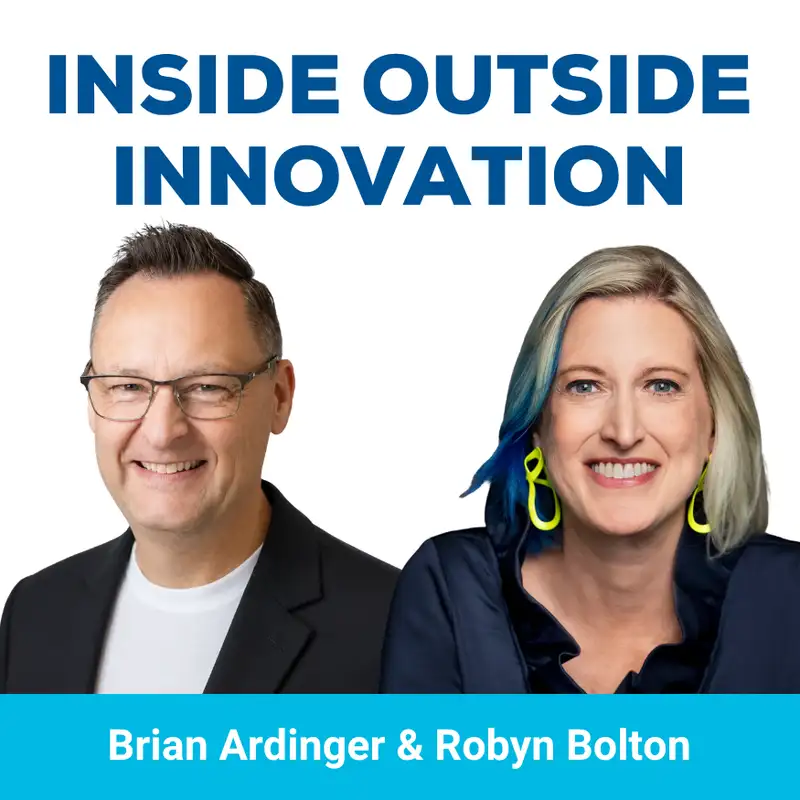
Synthetic user research, AI fog future, and AI readiness with Brian Ardinger and Robyn Bolton
On this week's episode of Inside Outside Innovation, we talk about synthetic user research, the future of AI fog, and why most companies aren't anywhere near ready for AI. Let's get started
Podcast Interview Transcript with Brian Ardinger and Robyn Bolton
Podcast Interview Transcript with Brian Ardinger and Robyn Bolton
[00:00:00] Brian Ardinger: Welcome to another episode of Inside Outside Innovation. I'm your host, Brian Ardinger, and with me I have Robyn Bolton. Robyn, how are you?
[00:00:24] Brian Ardinger: We are doing well here in Nebraska. We're getting ready for summer, all the fun things that are happening. So it's always fun to start a new season with some new information about innovation, so I figured we'd have a podcast and talk about it.
[00:00:38] Brian Ardinger: All right. We've got a number of articles that we want to talk about today. The first one we're going to talk about is The Counterintuitive Case for Building in Markets VCs Don't Understand by Todd Gagni. He's from Wildfire Labs. He has a interesting blog post talking about how startups can actually get a pretty big advantage if they zig instead of zagging when it comes to VCs and focus it on how do you actually build in particular markets that are very specific and niche such that you can gain some flywheel effect of knowledge and create a moat that a lot of other companies that are out there trying to do it if they're trying to go too horizontal.
One of the interesting things in the article, he talks about the, it's not the technology or first mover advantage, it's not funding, it's the learning that you have when you start working with specific customers in a specific market and it's over and over again, and that mode is that you understand the customer's world so well that it will help protect you against horizontal competitors that would need to catch up and they don't have the breadth and depth that you would have in that particular market.
Thought it was a fascinating way to look at how do you actually break into a market as a startup.
[00:01:44] Robyn Bolton: Yeah, I love this. And usually, the advice I think that all entrepreneurs in any industry get is, pick an industry, pick a niche, and go all in. And, usually I don't love that for myself because I love the randomness of consulting.
But this I fully agree with because, success, in my opinion, is all about customer empathy and deeply understanding your customer and serving your customer. And especially if you're an entrepreneur who's building something, an app, a platform a whatever, a widget really deeply understanding your customer and their pain points and how they use things and what works and what doesn't. That will always get rewarded.
One size fits all doesn't exist, and so when companies come out like, "Hey, we do everything," I'm reading more and more about the Everything app, it's ugh, you're not going to do anything well. But that's what VCs want to hear, right? That's what funders want to hear, because it's a big total addressable market.
And so I was just, I thought it was great that this got called out as hey, you know what? Go really narrow, deeply understand your customers, and don't worry about VC, because the market will reward you. And that's ultimately what you want.
[00:02:57] Brian Ardinger: And I think the other thing that often gets missed, and I think we talked about this in past episodes, is the fact that a lot of times it's very easy to say, "Go and find your particular niche and just nail that particular customer profile," and that.
But a lot of times at the early stages, you have a hunch about a particular problem or s- solution out there, and y- you have to hunt and wander and explore sometimes to find that core niche... to find those early adopters that actually you know, match the problem and solution that you want to try to build with them.
And so it's not, it's not to say that you have to have the niche from day one, but the closer you can find to finding that group of people that have that particular problem that you can solve, and you know inherently how to solve that for them you have a much better chance of creating those relationships, creating that moat versus trying to serve everybody at once.
[00:03:43] Robyn Bolton: Yeah, it's a great point. You want to be flexible, and I think that's why so many of the entrepreneurs or the startups we look at now who've been wildly successful, a lot of times it's the founder who had that problem and was in that niche and- was that customer and, went from there to, to make sure it wasn't just a market of one.... But that there were other people, and so they were out there willing to learn.
[00:04:05] Brian Ardinger: Absolutely. All right. The next article is from our friend Ben Yoskovitz. He has an article launching his new synthetic user research platform called Candor. And so, I've got a call with Ben next week. I think you met with him this week. And what Candor is a synthetic user research tool. So basically, what they're trying to do is create a AI that creates personas that allow you to interview the personas and get, feedback from what are effectively AI customers either manually or automatically through a particular process that allows you to get some additional insight versus having to go out and interview real humans.
And obviously there's, nuances to all that. But I'd love your take on the move from AI to kind of creating personas and using AI as your customer.
[00:04:50] Robyn Bolton: Yes, so this is something that actually for the last couple of years I've been looking at. So, a couple years ago I tried a service for quantitative research using synthetic personas, and I was really impressed by what it did, but I was still very skeptical about synthetic personas for qualitative research.
I think I've talked before about how jobs to be done is the hill that I will die on. It requires a very specific way of interviewing that is much more natural conversation. It's not following, a script. And for that reason, I was like, "There's no way synthetic personas in qual will work."
And so after reading this article a couple weeks ago, I reached out to Ben and had a, actually, as you said, had a conversation with him this week, and he took me through Candor. And I haven't used it, but I was impressed with what I saw, because what Candor does is it actually, as it's ... It's funny, you can have the AI Candor, interview the synthetic persona, so it is bots talking to bots.
But the interview, and you can get a transcript of the interview, follows a conversation. It doesn't follow a script. And, having trained a lot of people on how to have jobs to be done interviews, I can tell you that's the hardest thing to train a person to do, which is have a conversation and not follow a script.
So, I was really impressed with the thoughtfulness and what looks like, a really high-quality experience, high-quality learning. Now, like I said, I haven't used it yet, so I can't say how well does it work, how well do the personas come in. But this really was the first thing that I looked at, I was like, "Okay."
It is not a replacement for actually going and talking to humans, but this feels like it can get you pretty far so that you're using those conversations with actual humans for the greatest, value creation and benefit.
[00:06:49] Brian Ardinger: The other thing I think this tool could be used for is the practice. You said- ... research is hard. Knowing what questions to ask, how to ask them, things along those lines. And if you can have almost as a training ground for practicing answers, seeing how they come back, how the AI responds to it when you go and ask a customer, "Wouldn't it be great if you could do XYZ?"
Of course you're going to get positive feedback. And so, knowing how to phrase questions, h- how to probe deeper and using this as a tool to both practice as well as just get different types of insights before you actually go out and talk to real humans could be a very interesting value proposition for it as well.
[00:07:23] Robyn Bolton: Yeah, absolutely. And another benefit is that because you have these personas, you can keep going back to them and asking them. As you think about, first you'd kind of do discovery interviews to figure out what the pain points are, then you do concept tests to get feedback on rough prototypes, and it's very hard, if not impossible, to talk to the same humans at every step of the way.
So, you're piecing- things together. With personas, you can go back to the same persona, and in Candor, it remembers what it said previously, so you're having a repeated conversation through the entire development process, which, again, isn't a substitute for talking to people, but it is a wonderful additional benefit.
[00:08:09] Brian Ardinger: Absolutely. And Ben is the author of Lean Analytics and founder of, co-founder of Highline Beta, so he's been in the trenches since the beginning of all the lean startup movement learning how to interview customers and build up new products. I thought it was a very interesting thing. We'll see how it goes, and we'll maybe have a future forward follow-up on. all this as well, all right.
[00:08:27] Brian Ardinger: Stay tuned, yes. The next article we want to talk about is from Daniel Missler. It's called Most Companies Aren't Anywhere Near Ready For AI. And what I found interesting about this particular article is it really went to the heart of a lot of the struggles I think companies are having when it comes to implementing AI.
AI is really not about just the execution. It's about what are you executing on. And he talks about how most companies aren't ready because they don't actually know what they need to optimize how the tasks and processes actually work, where can AI fit in, and where is it a good use case scenario.
And how do you scale something when you shouldn't be even scaling it in the first place? And so, I think one of the quotes is, "I honestly believe that the mass- vast majority of companies are in grave danger because they are essentially chaotic black boxes that barely work in the first place."
And so, when you start adding new tools such as AI into that black box you get some, strange results. And so, I think it hit to the core of how a lot of companies I think are struggling with how do they implement AI because they don't know exactly how to use AI in the first place and what they're using it on.
[00:09:36] Robyn Bolton: Yeah, this article was, one, just rife with great quotes like the one that you had that there's another one, "A massive percentage of companies are haphazardly successful despite themselves." They're just great quotes that are going to resonate with anyone who has ever come in contact with a company.
And he makes such a great point. Right now, we read about how the vast majority of AI pilots aren't getting scaled. We're reading about how companies are spending billions of dollars in AI and not seeing the results. And I think it's, one, because a lot of companies are treating this as, hey, we're just rolling out, a cloud system or an ERP system.
And they, as he, as the author, as Daniel makes the point, they can't explain what they want to do. They can't explain how they execute today, and AI can't replicate how they are executing, so there's just that lost in translation. But then the bigger issue is that things need to be redesigned for AI.
It needs to be blank piece of paper. So even trying to replicate AI executing what you do today is the wrong goal, but even that goal is getting missed.
[00:10:50] Brian Ardinger: And it gets more complex as you look across an organization. When you look across organizational goals- ... workflows, operations, decision-making, the teams itself, the spending and the budget around all that it gets more and more complicated.
And so if you're not very clear on how to execute on that in the first place adding a tool that, has its challenges and benefits can make it even worse if you're not ready for it. So, I think the end result is, spend a lot more time preparing for AI versus just throwing it in there and seeing what happens when you do.
[00:11:24] Brian Ardinger: That leads us to our last article today, which is The Future Is Shrouded in an AI Fog from Harvard Business Review. And this kind of, I think, points to a lot of stuff we talked about. We are living in a world where everything is murky of how do you actually create value, how do you build using new tools, how do you change the way culture is and how people react to these cultural changes. And this Future Is Shrouded in AI Fog article talks about one of the ways you can do this is think about it differently than you have in the past.
So rather than saying, "What is my 10-year return on a particular investment?" Think about it from the standpoint of what is the smallest commitment we can make now that builds us information and is right that we can actually then you know, follow it and continue to grow rather than making these big bets and expecting the world to be sane and familiar and the same for year over year.
[00:12:16] Robyn Bolton: Yeah. There definitely is fog. I call it we're in the primordial ooze of the next, I don't know, the next economy, the next whatever the next world. And the point made here is there's a great point that risk is quantifiable. One can assign probabilities that allow us to place a bet, but uncertainty is unknown, and it's not quantifiable. And we are very much in this fog, in this primordial ooze, in a point of uncertainty. And so, it's not an excuse to go entirely short-term and only focus on the next quarter or the next year.
But you also, as, the point you mentioned, you can't look at 10 years out and just say, "This is where we're going in 10 years," and go all in on it. It's and, not or. You have to say, "Okay, where do we think we need to be in 10 years?" Set that vision and then take the little steps that preserve flexibility and preserve the option value while moving forward. And so, it's just a great reminder that we need to work in different ways, in iterative ways, but we can't, we shouldn't be all in on just the short term or, and can no longer be all in on the long term
[00:13:25] Brian Ardinger: And the key may be how do you embed optionality into everything So whether it's, how do you deploy capital and options from that perspective to the actually organizational design itself, how do you allow for change and adaptability- knowing that is going to happen in a world that we're living in right now?
[00:13:44] Robyn Bolton: Yeah. And it's definitely a systems, it's definitely a process challenge. It's also going to be a human and an organizational challenge because when things change, I think the instinct now is to blame people. "You were wrong, you read this wrong." And it's no, things are changing because we're getting new information, new technology is coming online. And so change is good, it's just a fact of life, and we have to adapt to it. And culturally, some companies, some organizations need to build that muscle of forgiveness and understanding.
[00:14:17] Brian Ardinger: Absolutely. Hopefully, we've given you a little clarity this week into some of the fog that we're all experiencing. I appreciate everyone coming out for Inside Outside Innovation, and we'll see you next time.
[00:14:28] Brian Ardinger: That's it for another episode of Inside Outside Innovation. Today's episode was produced and engineered by Susan Stibal. If you want to learn more about our teams, our content, our services, check out insideoutside.io, or if you want to connect with Robyn Bolton, go to milezero.io. And until next time, go out and innovate.
Articles Referenced
Articles Referenced
- The Counterintuitive Case for Building in Markets VCs Don't Understand - Todd Gagne
- Launching Candor: A Synthetic User Research Platform - Ben Yoskovitz
- Most Companies Aren't Anywhere Near Ready for AI - Daniel Meissner
- The Future Is Shrouded in an AI Fog - HBR