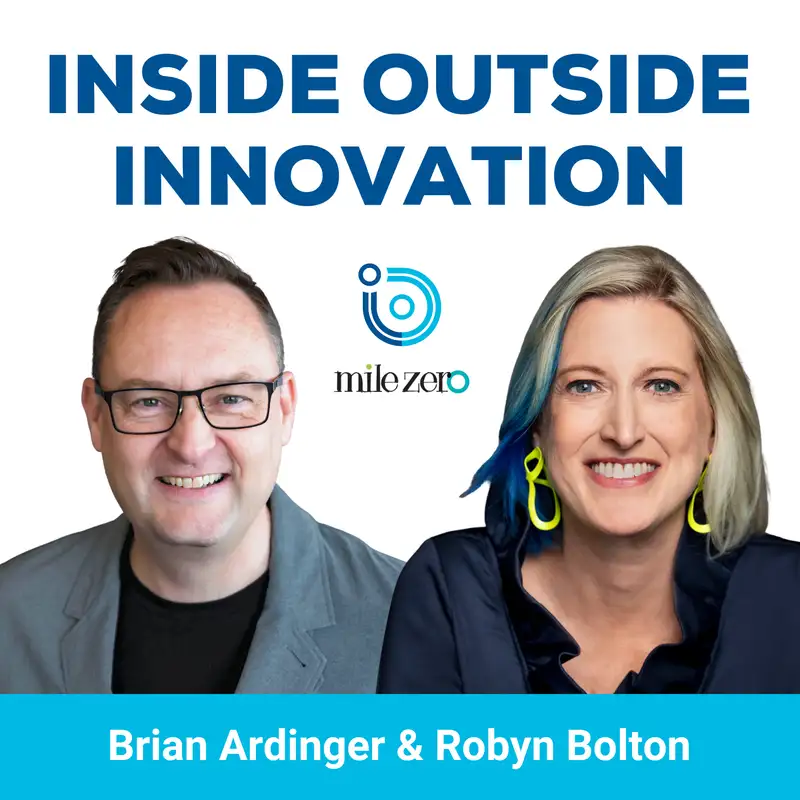
AI Judgment, Work Trends, and the Angel Investor Gap with Brian Ardinger and Robyn Bolton
On this week's episode of Inside Outside Innovation, we talk about Anthropic's bet on philosophy, trends shaping work in 2026, and why we need more angel investors. Let's get started.
Inside Outside Innovation is the podcast to help innovation leaders navigate what's next. Each week we'll give you a front row seat into what it takes to grow and thrive in a world of hyper uncertainty and accelerating change. Join me, Brian Ardinger and Miles Zero’s Robyn Bolton. As we discuss the latest tools, tactics, and trends for creating innovations with impact, let's get started.
Podcast Transcript with Brian Ardinger and Robyn Bolton
Thinkers50 Recognition and the Role of Modern Management Thinkers in Innovation
Podcast Transcript with Brian Ardinger and Robyn Bolton
Thinkers50 Recognition and the Role of Modern Management Thinkers in Innovation
[00:00:30] Brian Ardinger: Welcome to another episode of Inside Outside Innovation. I'm your host, Brian Ardinger. And with me, I have Robyn Bolton. Robyn, welcome to the show.
[00:00:45] Brian Ardinger: We are excited as always, to talk about innovation and all the things that we've learned. Anything going on in your life that you want to share?
[00:00:52] Robyn Bolton: Got some exciting news actually a couple weeks ago. Don't know if folks are familiar with Thinkers 50. That is kind of like the list of the top management thinkers and they have a radar list of up-and-coming thinkers and found out that I got named to that list.
[00:01:15] Brian Ardinger: It's always good to be recognized and even more to be recognized as a thinker. I think, especially in today's world.
[00:01:21] Robyn Bolton: Yes, yes. Thinking is good. Doing is good too. And you know, it's an organization, they always say thinking plus doing equals impact. And I'm like, yep.
[00:01:36] Brian Ardinger: Right now, we are buried in seven inches of snow, so that was fun. The week before we were in Phoenix, so I think I picked the wrong week to go on vacation. Other than that, unburying from email and unburying from snow this week. So, it's all good.
[00:01:53] Brian Ardinger: Exactly. Remember what it was like. Excellent. Well, let's get started. We've got a couple of different articles over the last few weeks. The first one we want to talk about is a YouTube video from AI News and Strategy Daily by Nate b Jones.
He had a video a couple weeks ago talking about Anthropic CEO's bet on the company and his philosophy, and the data says that he's right, that he's thinking about things in a little bit different way. It really talks about the constitution that Anthropic has put together. They put together an 80-page Claude constitution outlining the principles of how they've developed Claude and thinking about it, quite frankly, in a different way than a lot of the other AI companies have been thinking about it.
What they've said that they've done is really look at how do you build these AI models using core principles, rather than having to build out every single rule and what the AI has to do based on rules and more about what's the philosophy of how the AI model should think through the system so that gives it more flexibility.
And basically, this idea of having a more. Flexible constitution or way of thinking versus a strict rules-based approach may actually be a, a way that is going to give Claude an edge in the future.
Anthropic’s Claude Constitution, AI Judgment, and the Future of Large Language Models
Anthropic’s Claude Constitution, AI Judgment, and the Future of Large Language Models
[00:03:05] Robyn Bolton: Yeah. This was really fascinating because it brought up a theme that we've talked about several podcasts since the start of the year, which is judgment.
And we've always talked about, and we've seen it written about it, it's like, hey, judgment is what is going to continue to give humans relevance. Because we have judgment and AI is just rules based. And so, what was fascinating and terrifying was in this constitution, it's based on Aristotle's philosophy and it emphasizes that they're trying to build Claude to exercise judgment versus following rules.
And I was like Uh oh, if that was the, a human moat to kind of give us relevance and we're building Claude that I use daily to exercise judgment this is going to result in some very interesting things. And so, kind of early on, obviously Claude has not progressed to being, having full wisdom and judgment. But now with this constitution, one of the things that Nate mentioned is that when you're prompting Claude, the why matters more than the what.
So, the importance because of this constitution and how they're programming Claude, that when you ask for something, you're going to get a better response if you explain why you're asking for it versus all of the other, you know, chat, Grok, Gemini, et cetera, you can just put a request in and it will answer. So, I thought that was interesting.
[00:04:35] Brian Ardinger: The idea of having additional context and giving the LLM, the ability to take that context into decision making, I think is where it's different versus saying, you know, you have to go on a particular path, but based on the context of that path, you may have different outcomes.
And that's just like in real human life, when you're presented with problems or forks in the road, you oftentimes take into consideration all the context around it rather than a specific rule. Like in this particular case, I have to follow this particular rule. And sometimes that's not the case. Sometimes you break rules as a human, because you know the context is different. And so, I thought it was interesting that they're trying to build that into the LLM and we'll actually see if, you know, if it actually helps or how that differs with the outputs as things change.
[00:05:18] Robyn Bolton: The brave new world.
HBR Trends 2026, AI in the Workplace, and the Future of Work Strategy
HBR Trends 2026, AI in the Workplace, and the Future of Work Strategy
[00:05:19] Brian Ardinger: All right, speaking of Brave New World, we've got a couple of different articles that we brought up last week talking about trends. And the first one we want to talk about is an HBR article talking about Nine trends shaping work in 2026 and beyond. And this goes into a lot of different topics and I think the primary topics are really around how are people thinking about AI? How are people unlocking value from ai? How are employees engaging with this? It's not necessarily trends, but this is the reality of the world. So what are your thoughts on this article?
[00:05:48] Robyn Bolton: Yeah, this one, when I opened it to read through it, I was like, okay, trends, like, let's go, like what's coming down the pike?
And after reading, I kind of felt like, oh, this was my new summary of the day, because it goes into AI layoffs, outpaced ai productivity gains. Yep. Check. Culture dissonance holds organizations back from performance goals. Chit check. That's been true for a while. AI takes toll on employees’ mental fitness. Nailed that one. And, and it goes on.
And I, so I just thought it was very funny that this was talked about as trends when I would say like, these have become everyday realities for people just could have been any type of organization.
[00:06:30] Brian Ardinger: It'll be interesting to see how these play out. Some of the things they talk about are, you know, how forward-thinking employees are, quote unquote, restoring humanity to the hiring process.
And they're thinking about, you know, not just the ability to sift through resumes and that, but like actually looking for things like judgment, things like, how do you actually understand what the person is building and why. Those are becoming more and more important. As we've sped up some things through AI and that has caused additional issues or reactions that we're having to kind of back pedal a little bit.
Even things like, one of the trends I talked about is corporate espionage and the risks of that. And I was talking to another person this week about cybersecurity and how, you know, basically if anything goes into the cloud, there's a cybersecurity risk and so is that going to lead to this, maybe a trend towards putting everything onto a computer and going back. Rather than the whole cloud infrastructure, maybe we go back to a, a model where everything's, you know, based on hardware in your desk and how that might change the world.
And so, there's a lot of different things that are hitting so fast that I think we're getting slightly ahead of ourselves. And then we take a step back and then we go ahead of ourselves and we take a step back. And it, it'll be interesting to see, can we keep up with that pace? Or what happens in the process.
[00:07:38] Robyn Bolton: At times it feels like kind of the red queen problems. They say for any Louis Carroll fans out there that you have to run twice as fast to stay in the same place. There's that, but there's also, as you said, taking a step back and again, kind of humans are the solution for a lot of these ills.
Meta Trends, Angel Investors, and Building Startup Ecosystems Beyond Silicon Valley
Meta Trends, Angel Investors, and Building Startup Ecosystems Beyond Silicon Valley
[00:07:55] Brian Ardinger: Then the other trends article, we're not going to get into it too much, but Matt Klein, Matt has a zine at kleinkleinklein.com and every year he takes a look at these meta trending trends and he analyzes, you know, all these different global trend forecasts and that, and tries to put it into a report that analyzes and looks at the shifting meta trends, kind of the bigger trends based on all the trends that he reads.
It's a great opportunity to go through that. It's a pretty thick report every year, but he looks at everything from cultural trends to technology trends, and is a very good resource to take a look at.
[00:08:27] Robyn Bolton: This is my go-to for all trend work because he does heroic work of reading 70 plus Global Trend Reports parsing 400 plus trends into Excel bless his heart. And yes, AI is used a bit in this, but this is not outsourced to AI. And he actually even describes in the post what he lets AI do and, and what he doesn't. And so like this really is the compendium of true trend, not trends that have actually already happened.
[00:08:57] Brian Ardinger: And Matt's been involved with Reddit. He actually came out and spoke a couple years ago at the conference, and he is a great resource. The third and final article of this week is from Ben Yoskovitz. Also, a person who's come to the IO summit in the past. Ben's a good friend of ours and he has a new article talking about we need more angel investors.
In this article, he talks about the changing dynamics, and we've talked about this in the past where anybody can now spin up things. You can have a lot more new startups can spin up, but there's a key component. He believes in the ecosystem that you have to have. You have to have funders and, and folks that can help get these particular ideas off the ground, even in the case where you don't need as much capital to get some of these ideas off the ground.
[00:09:39] Robyn Bolton: Another one of those articles where I kind of went through the full spectrum of emotions and agreement and disagreement as I read it. Because I think the point he's making is very true and much more nuanced than the headline would lead you to believe.
What he describes in the article are, yes, we need more angel investors because we need early-stage funding. And those are angel investors who have experience that they can bring to bear to help the founder. So, this isn't just somebody with money who likes to play startup investor. This isn't, you know, angel investing groups that are alumni associations. It's a very specific kind of angel investor that he's talking about.
And when you put, you know, those criteria, those constraints on it, I'm like, yes. A hundred percent. We need angel investors who can help and advise founders.
[00:10:32] Brian Ardinger: And he outlines the fact that he thinks it's even more important in places outside of major startup hubs where again, you can find an angel investor at every single coffee shop in Silicon Valley, and then some, probably back-to-back, all ordering the same different coffees out there.
But in a place like Lincoln, Nebraska, or other places outside the, the gold coasts of the east and west, it's harder to find those investors not only with the experience, but also just the fact that they're willing to bet on early-stage ideas. You know, in an area outside of major startup hubs, you generally have much more of a conservative environment such that it's hard to make those bets on the back of a napkin.
And that's typically what angel investors are, are good at, is, you know, funding these crazy little ideas and giving them a little bit of gas to see if they're on the right path. And it's hard to find those folks. And building a culture that you can have more angel investors be created in your backyard that are willing to take bigger bets, more risk at the early stage, and help those founders get traction, sell their stories, find their first hires. All those things are vitally important in an environment where it's not as dense, where you don't have as much ability to stumble into that as a founder.
[00:11:38] Robyn Bolton: Which is exactly why events like the Inside Outside Conference, which is coming up, is so, so important because you've, for a period of time, increased the density in places outside of the coast and bring all of those people that are so critical to the ecosystem together.
[00:11:57] Brian Ardinger: And that's another episode of Inside Outside Innovation. We look forward to having further conversations and we'll see you next time around.
That's it for another episode of Inside Outside Innovation. Today's episode was produced and engineered by Susan Stibal. If you want to learn more about our teams, our content, our services, check out insideoutside.io or if you want to connect with Robyn Bolton, go to MileZero.io, and until next time, go out and innovate.
Articles Discussed
Articles Discussed
- Anthropic's CEO Bet the Company on This Philosophy. The Data Says He Was Right. - Nate B. Jones
- 9 Trends Shaping Work in 2026 and Beyond - HBR
- The META Trending Trends: 2026 - Matt Klein
- We Need More Angel Investors - Ben Yoskovitz